
"Best Practices" 
Internal traceability
|
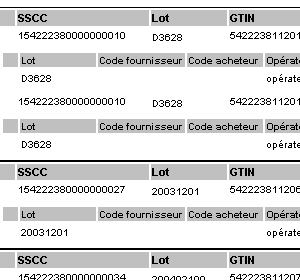
By law you must keep an input / output list (journal) containing the description of all items, together with the link between items.
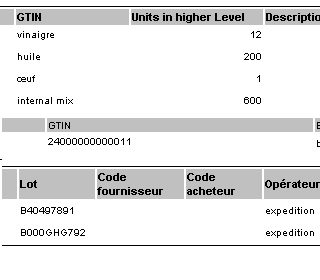
Your Internal traceability procedure will keep all relations between raw materials and finish goods, boxes (pallets) entering the plant and those leaving. The same rules will be applied in case of distribution : keep the links between goos purchased and (re)sold.
|
||||
The law also define action to take :
|
||||
| tracking | tracing | |||
|
|
|||
External traceability
| To build Internal traceability information,
you will have to keep the link from the incoming traceability data (date of production, best before date, batch number,
quantity, SSCC, ...) to the outgoing traceability data. By law, you must transfer traceability information to your customers. Volumes are so large that there is only 1 way to go : electronically! |
||||
|
ERP (SAP) + EDI + Intranet + WWW + services 24/7 = External traceability |
|
|||
Logistic labels
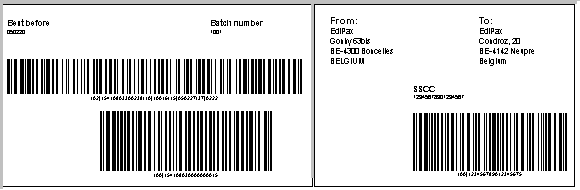
| When packing (homogeneous parcels, pallets), they may contain traceability information ! When shipping (non homogeneous parcels, pallets), they cannot contain traceability information. You will have to open the boxes... ! |
||||
|
GTIN + GLN + SSCC + EAN128 =Logistic labels |
|
|||
Minimum legal
EdiPax is helping !- just open the document and fill information in;
- you can print your barcode labels and stick them on top of parcels and pallets you send to your customer: go on-line
free of charge - click here: Net connectivity prices
It is a legal requirement throughout Europe, as from 1st January 2005 !
The solution EdiPax does propose today is already designed this way.
The solution EdiPax does propose today is demonstrating modern traceability method.
Thanks to upwards compatibility you will be able to upgrade from the "Minimum legal" solution to more sophisticated solutions, step by step, at your pace !!
Basic Solution (EAN Basic)
An ERP package is not required to implement the EdiPax solution, meeting "Best Practices" ( basic level) EAN requirements:- Nature of the incoming product (type of product, product name, brand)
- Identification of that product (GTIN/batch number for crates/boxes or SSCC for pallets)
- Quantity of the product
- Reception date
- Identification of the supplier (name, address, location)
- Identification of the received products which do not meet the required quality standards
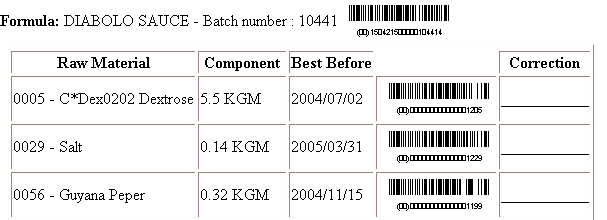
- Link between the GTIN/batch number or the SSCC of the received raw material(s) / good(s) in process and the new GTIN/batch number of the produced unit
- For each following production phase : link between the GTIN/batch number(s) of the good(s) in process (either self produced or not) and GTIN/batch number of the newly produced unit
- composition (for mixed products)
- weight
- production line
- production date/hour/min.
- GTIN/batch number of the crate/box and SSCC of the pallet
- packing date
- product quantity per packaged unit
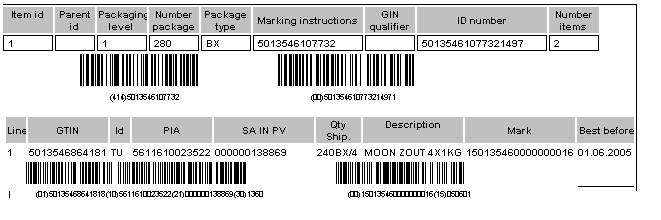
- In case of a box, crate, ... : GTIN + batch number in a UCC/EAN-128 bar code
- In case of a pallet : EANUCC Logistics Label (product section) with UCC/EAN-128 bar code
- Address data (Name-Address-Location) of the company
- number/quantity of the retail units
- Stack the units according to the FIFO system
- Verify the quality of the stored unit
- Allocate an order number
- Link of the new order number to the GTIN/batch number(s)/SSCC of each newly composed order
- Quantity of packed unit(s) composing the order
- Link of the order number to the delivery address (customer)
- Link of the truck’s license number to the order number
- Information regarding transportation :
- transport date
- Label the logistic units with the EANUCC Logistics Label (transport section)
- Verify the quality of the logistic units
- Generate a delivery slip(paper) for the truck driver mentioning the following data :
- identification of the logistic units (GTIN/batch numbers for boxes/crates and SSCC for pallets)
- number/quantity of the logistic units
- delivery address
- transport date
Extras included in the package, to help you to:
- you can print packing and shipping labels using a standard laser or thermic printer
- we will keep a backup copy of your data inside our environment during the required period
- 8 European languages to input and print your despatch advices and your invoices, including the traceability information of the products you sell, following legal requirements
+ implementation of Internal traceability and data entry automation
+ implement EAN High "level", recommended "Best Practices"
Advanced solution - EAN High
A CAPM / ERP is recommended but not required to implement the EdiPax solution meeting "Best Practices" ( high level) EAN requirements:
On top of "Basic solution" :
- Reception and storage of raw materials/ goods in process
- Identification of the transport operator
- Control data on quality of the received products
- Party identification codes of the previous partner(s) in the chain
- Production
- results of quality controls
- country of origin
- Packing and labelling
- results of quality controls
- the different GTIN/batch numbers composing the package
- country of origin
- Verify the quality of the packed unit
- Scan the EAN bar codes when entering into stock
- Storage
- a company premise (storage room, cooling cell, ...)
- a pallet location
- Shipping
- results of quality controls
- information on the truck driver (name, company, ...)
- Generate and send the despatch advice (DESADV message)
- EdiPax EDI connectivity, to exchange documents with your customers
- Your External traceability on the WWW
- You will find all "Best Practices" details, recommended by EAN, on http://www.eanbelgilux.be/PAGE/bestpractices_dec2003_ENG.doc
Thanks to upwards compatibility you will be able to upgrade to the "EAN-high" requirement and / or more sophisticated solutions, step by step, at your pace !!
Tailored solutions
Wed also do propose you:- automated data exchange from/to you ERP software, to save data entry ( resource saving and higher quality )
- site specific solutions
- Internal traceability implementation
References
-Le moniteur Belge du 12 Decembre 2003 publie l'arrête royal du 14 NOVEMBRE 2003 relatif à l'autocontrôle, à the notification obligatoire and à the traceability dans the chaîne alimentaire sous les references "F. 2003 -- 4704 C -- 2003/23054"
-general food safety - 1992/59/CEE - 29 june 1992
-Batch Identification - 89/396/CEE - 14 june 1989
-AR de l’ AFSCA du 14 novembre 2003 en matière d’autocontrôle, de notification obligatoire and de traceability dans the chaîne alimentaire
-AR du 9 fevrier 1990 relatif à l’identification du lot auquel appartient a denree alimentaire
-Global Food Safety Initiative (GFSI)
-ISO9000
-Sector specific guides published by professional associations